Chimney and Skylight Leak Repair
Most of the brick chimneys in Forest Lake, The Downs and the Druid City historic district went up between 1946 and 1972. The roofs over them have been replaced two or three times since; the step flashing against the brick, in a lot of cases, has not. Chimney flashing leak repair in Tuscaloosa is mostly fixing what 50-year-old flashing and 15-year-old sealant can no longer hold back.
Skylights are the same story on a shorter clock. We handle both as flashing jobs: new metal, proper layers, no caulk-only repairs.
Why chimneys leak in older Tuscaloosa neighborhoods
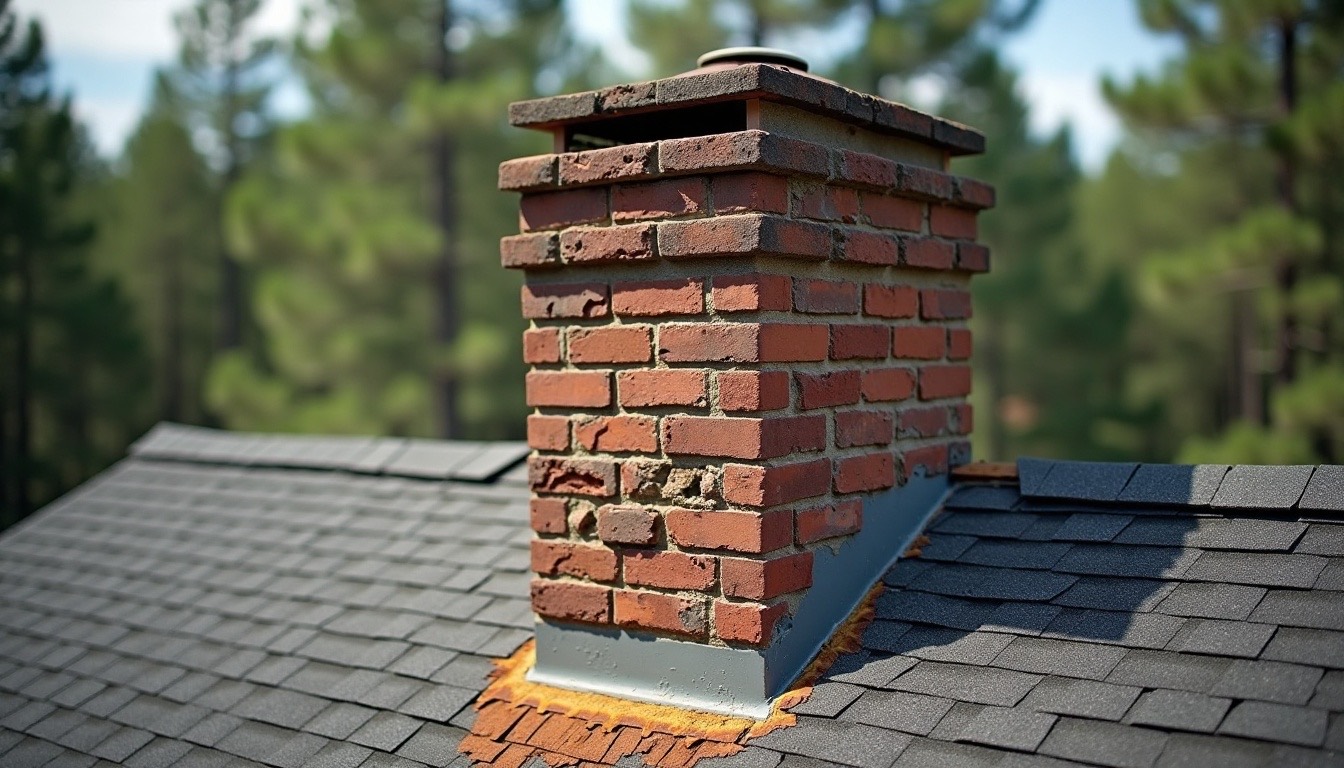
A chimney is a 4-to-6-foot-wide wall standing in the middle of a roof slope. Every drop of rain uphill of it hits the back side and has to go around. On the 1950s and 60s ranches in Forest Lake, Alberta and West End, the back side usually has no cricket, the little peaked saddle that splits water to either side, so leaves pile up, water stands against the brick, and it finds the mortar joint where the counterflashing was tucked in 50 years ago.
Add the Tuscaloosa pattern of wind-driven rain, hours of it sideways from a spring front or an August tropical remnant, and water goes straight through hairline mortar cracks and under flashing that has lifted an eighth of an inch. The leak shows up as a stain on the ceiling or wall next to the fireplace, often only two or three storms a year, which is why it goes undiagnosed for so long.
There is a second layer to it on these houses. A lot of them had a second roof laid over the first in the 1980s or 90s, and the roofer at the time ran new shingles up to the old flashing instead of pulling it, so the step flashing is now buried under two layers with its top edge below the surface. Water gets under the top layer, hits the old flashing, and runs behind it. The only honest fix is to strip back to the deck around the chimney and start over.
Step flashing, counterflashing and the cricket
Chimney flashing is two layers. Step flashing is L-shaped metal woven in with each course of shingles up the side of the chimney. Counterflashing is a second piece let into a mortar joint above it and bent down over the step flashing, so water running down the brick drops onto metal, not into the seam. When a roofer skips the counterflashing and runs a bead of caulk along the brick instead, you get about three Tuscaloosa summers before the caulk opens.
Our reflash removes the shingles around the chimney, installs new step flashing with each course, grinds a reglet into the mortar joint, sets new counterflashing in it, and seals the joint with a polyurethane masonry sealant rated for the heat. Chimneys wider than 30 inches get a cricket built on the uphill side, covered in ice-and-water membrane and metal. A full reflash runs $550 to $1,300; adding a cricket puts the job at $900 to $1,800.
You can check some of this from the yard with binoculars. If you see a bead of caulk running along the brick where metal should disappear into a mortar joint, you have no counterflashing. If you see shingles running up to the brick with no visible metal at all, the step flashing is either buried or missing. If the back of the chimney is flat against the slope with leaves piled against it, there is no cricket. Any one of those is a leak that has either started or will.
Skylight seals and curbs
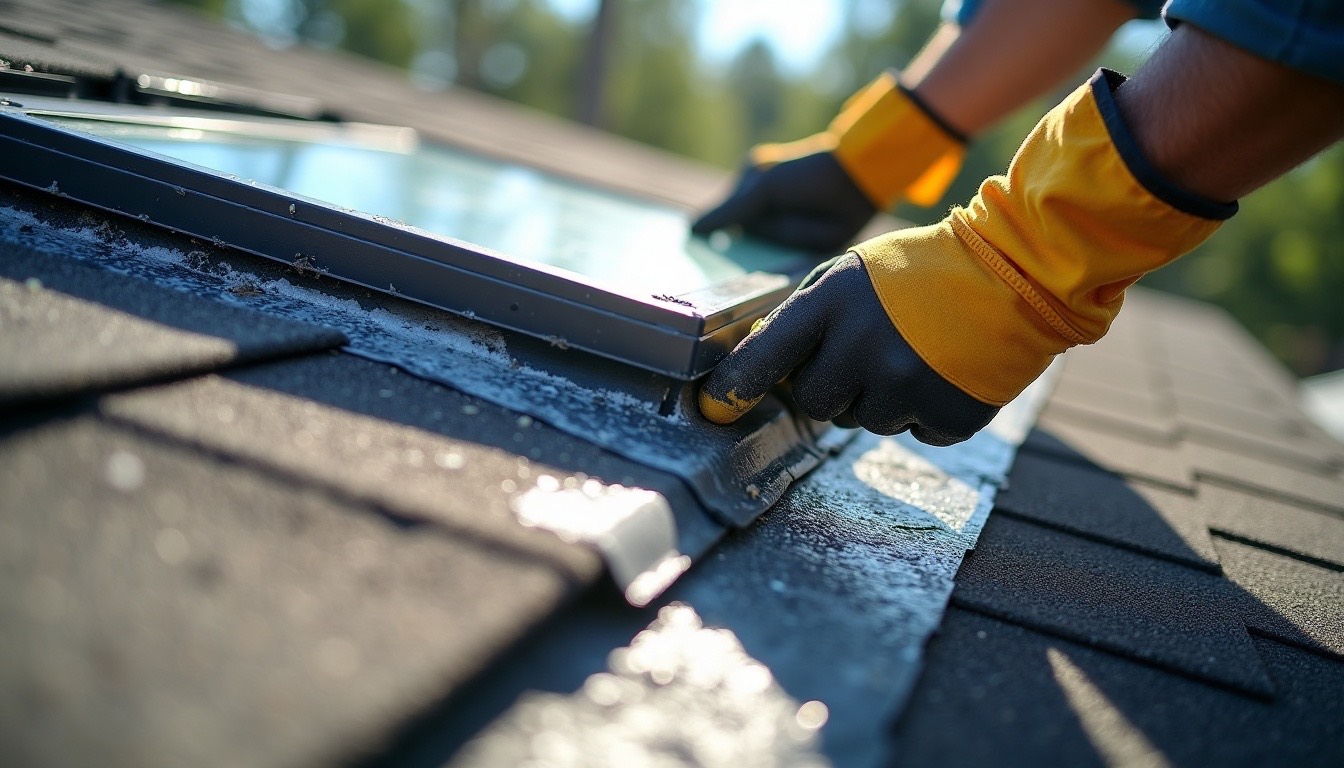
Skylights leak at three points: the seal between the glass and its frame, the flashing kit around the curb, and the shingles above the curb where debris dams water. Weeks over 90 degrees dry out the factory seal somewhere around year 10 to 15, and a lot of skylights in the 1990s additions on the south side of town and in the Rice Mine Road subdivisions are past that.
If the glass seal has failed you will see fog or moisture between the panes, and the unit needs replacing; we install a new deck-mount or curb-mount unit for $900 to $1,900 depending on size. If the flashing has failed, we strip the shingles around the curb, install a new step-and-saddle flashing kit, and reshingle for $500 to $1,100. A reseal alone, where the flashing is sound and only the sealant has opened, is $250 to $600.
Tubular skylights and sun tunnels, common in the 2000s houses out Rice Mine Road and in the Northridge area, leak at the dome gasket and the flashing collar for the same heat reasons, and we handle those at the reseal price. Whatever the type, we clear the debris dam above the curb and check that the shingles above it were cut with a gap; a skylight with no gap above it is a skylight with standing water against its flashing every rain.
Masonry or roof: who fixes what
A leaking chimney is not always a roofing problem. A cracked crown on top, missing mortar in the brick above the roofline, or a chimney with no cap lets water in from above and it runs down inside the chimney. That is masonry work. We check the crown and the brick above the roofline on every chimney call, photograph it, and tell you honestly if the water is coming from above the flashing. If it is, we can seal a crown and add a cap, and we will point you to a mason for anything structural.
The quick test is where the stain is. Water from a bad crown or missing cap tends to show up inside the firebox or as efflorescence, the white powder, on the brick inside the house. Water from failed flashing shows up on the ceiling or the wall beside the chimney and tracks with wind-driven rain. We will tell you which one you have before anybody spends money.
What it costs here
Chimney reflash with new step and counterflashing: $550 to $1,300. Cricket added: $900 to $1,800 total. Crown seal and cap: $250 to $600. Skylight reseal: $250 to $600. Skylight reflash: $500 to $1,100. Skylight replacement: $900 to $1,900 installed. Every number is written before we start, with photos of the failed flashing so you can see what you are paying to fix.
Stop the drip beside the fireplace
Send a photo of the stain and one of the chimney or skylight from the yard. We will book the visit, show you the flashing, and quote the fix in writing.