
Roof Leak Detection
The stain is lying to you. It marks where the water landed, not where it got in, and on a Tuscaloosa roof those two points are routinely 6 to 10 feet apart. Roof leak detection is the service for the stain nobody can explain, the leak two other roofers patched and missed, and the landlord who wants a diagnosis with photos before approving a dollar of repair.
Flat fee, written report, and the fee comes off the repair if you have us do it.
Why the stain lies
Water enters at a cracked pipe boot, a lifted flashing edge or a nail hole, then runs downhill on the top of the decking until it finds a seam or a nail to drip from. From there it travels along a rafter or truss bottom chord, soaks the insulation, and finally wets the drywall at the lowest point it can reach. A bathroom vent leak at the ridge can stain a hallway ceiling at the far end of the house.
Add the way Tuscaloosa rain arrives, sideways in spring fronts and late-summer tropical bands, and the same hole can leak toward two different rooms depending on wind direction. Patching above the stain is a guess. We do not guess.
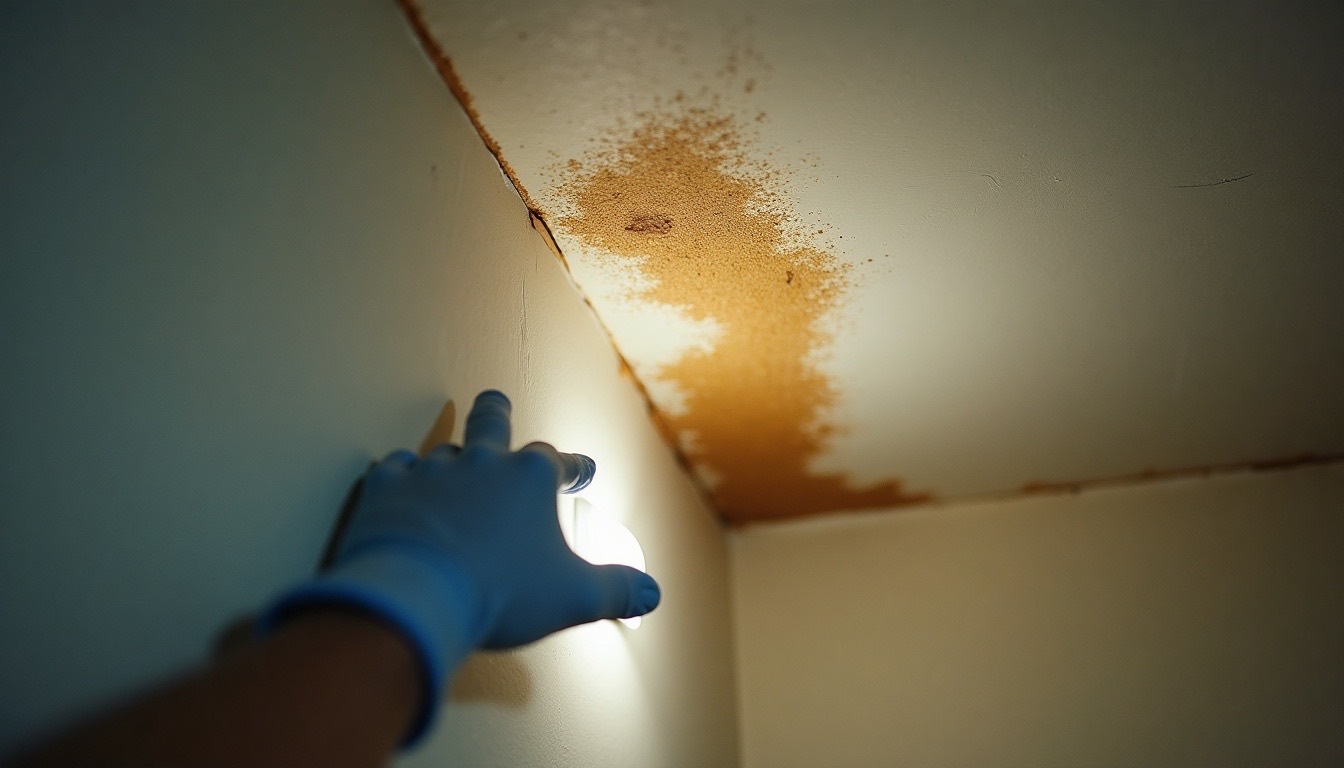
It also lies about size. A stain the size of a dinner plate is often the dry edge of a wet area three times as wide, which the moisture meter shows and the eye does not.
Attic first, then roof
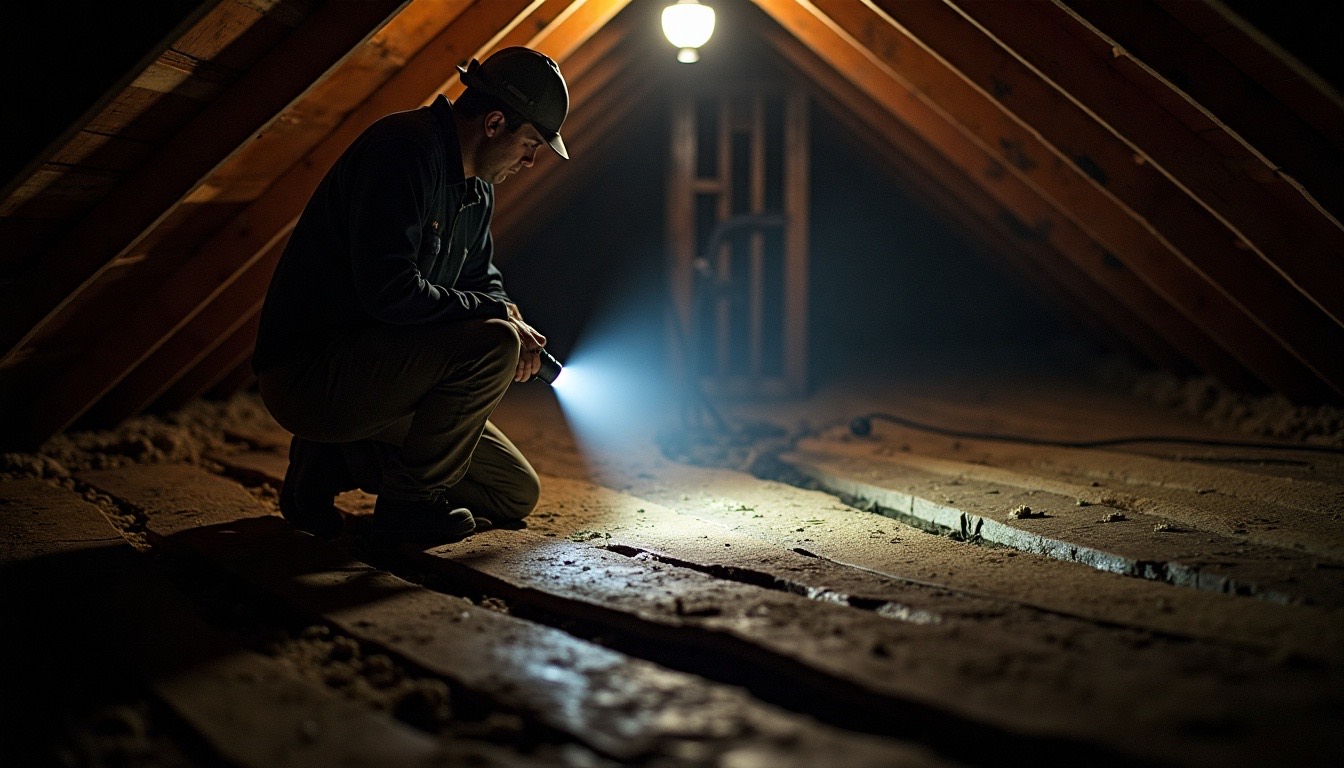
We start inside. With a flashlight on the underside of the decking, water leaves a trail: dark streaks, rust lines down a nail, a dull patch on OSB that has been wet more than once, mold spotting on a rafter face. We follow it uphill to the highest wet point, mark it, and measure its position from the gable or the ridge.
Then we go on the roof with that measurement and look at exactly what sits above the mark. Nine times out of ten in Tuscaloosa it is a boot, a vent, a chimney flashing edge, or a valley. On houses with no attic access, vaulted ceilings, or the finished attics common in Druid City and The Downs, we work from the roof with a moisture meter on the ceiling below.
The best time to trace is during or just after a rain, when the trail is wet and obvious, so if it is raining when you send the form, say so and we will try to get into the attic while it is still coming in. On a dry day the trail is still there; it is just dull instead of shiny, and we read it by the rust on the nails and the tide lines on the wood.
Hose test and moisture meter
When the trail is faint or there are three suspects within a few feet, we run a controlled hose test: one person on the roof wetting one component at a time, starting at the lowest point and working up, while the other watches the attic or the ceiling with a pin-type moisture meter. Each spot gets 5 to 10 minutes before we move up. When the meter jumps or the drip starts, we have the source, and we photograph it in the act.
A pin moisture meter on the ceiling also tells you how far the wet area actually extends beyond the visible stain, which matters when you are deciding whether the drywall can dry in place or needs cutting out.
A hose test takes 45 to 90 minutes on a typical Tuscaloosa roof and needs two people, which is why the roofer who shows up alone and looks for 10 minutes rarely finds the hard ones. We do it on a dry day so the only water on the roof is the water we are putting there, and we start low so we do not wet the real source by accident before we have tested the spots below it.
The photo report you get
Before we leave you have a short written report by email: the entry point with a photo, the water path, the ceiling moisture readings, what caused the failure, and a fixed price to repair it. If there is a second problem close to failing, it is listed separately with its own price.
Property managers around campus and along University Boulevard use the report to approve work by reply and to show the owner why the money was spent. Buyers use it to negotiate. Insurance adjusters accept it as documentation of cause.
Detection fee and credit
Roof leak detection in Tuscaloosa is $149 for a single-story house with attic access and $199 for two-story, steep, or no-attic-access houses where the hose test is the main tool. The fee is credited in full against the repair if we do it within 30 days, so a found-and-fixed pipe boot ends up costing the price of the boot. If you want the report only and plan to use another contractor, the report is yours and the fee stands.
Questions we get
How do you find a roof leak that no one else could?
By working from the attic up instead of from the stain up. The water trail on the underside of the decking leads to the entry point, and a hose test on one component at a time confirms it while someone watches inside with a moisture meter. Most missed leaks in Tuscaloosa are flashing edges or boots several feet uphill of the previous patch.
Does the detection fee get credited to the repair?
Yes. The $149 or $199 detection fee comes off the repair price in full if we do the repair within 30 days. The written photo report is yours either way.
Can a ceiling water stain be from something other than the roof?
Yes, and we check. Condensation on an uninsulated AC line, a bathroom exhaust duct that ends in the attic, a sweating water heater flue, or a window flashing leak on a two-story wall can all stain a ceiling. The attic trace tells us which it is, and if it is not the roof we tell you who to call instead.
Find out where it is coming from
Send a photo of the stain and tell us which room and which wall. We will schedule the trace, show you the entry point in a photo, and put the repair price in writing the same visit.